LUHMES 人多巴胺能神经元前体细胞系 / BioVector® LUHMES Human Dopaminergic Neuronal Precursor Cell Line
- 价 格:¥49950
- 货 号:BioVector® LUHMES
- 产 地:北京
- BioVector NTCC典型培养物保藏中心
- 联系人:Dr.Xu, Biovector NTCC Inc.
电话:400-800-2947 工作微信:1843439339 (QQ同号)
邮件:Biovector@163.com
手机:18901268599
地址:北京
- 已注册
BioVector® LUHMES 人多巴胺能神经元前体细胞系 / BioVector® LUHMES Human Dopaminergic Neuronal Precursor Cell Line
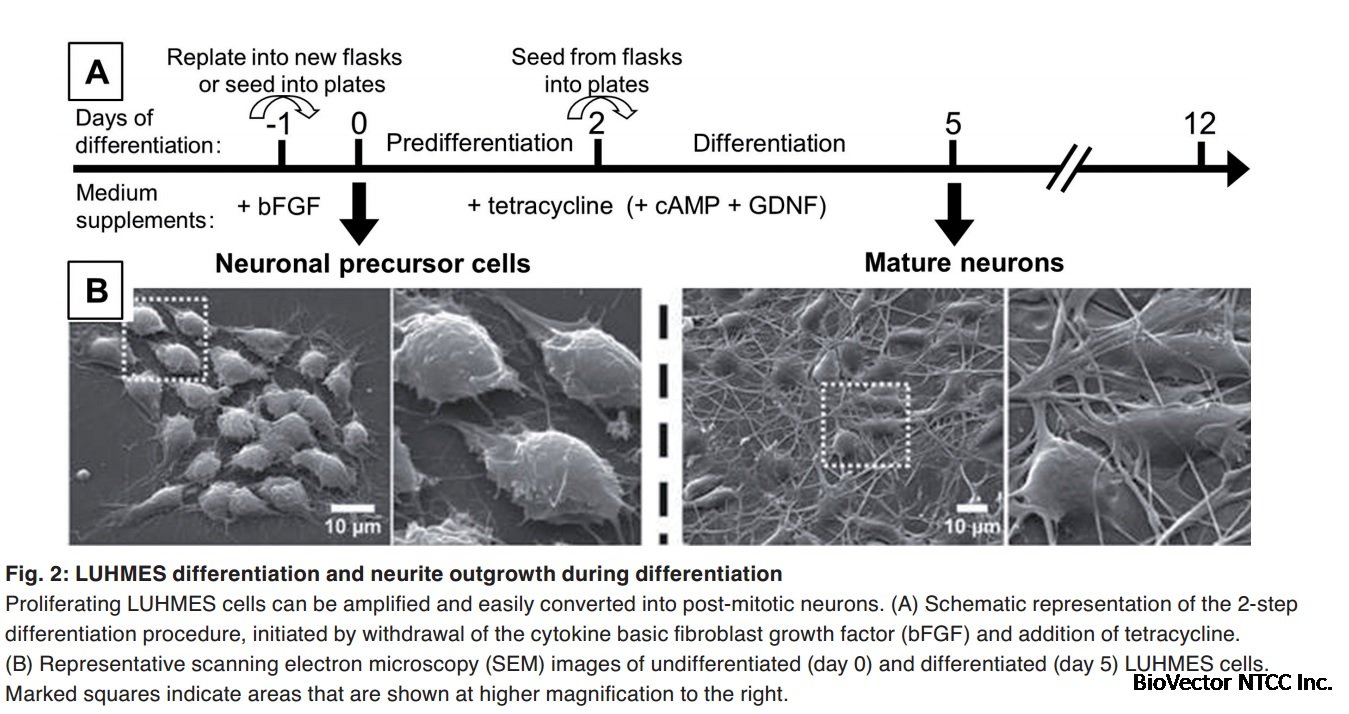
通用定义 / General Definition:BioVector® LUHMES(Lund Human Mesencephalic)是一种源自人类中脑(Mesencephalon)的多巴胺能神经元前体细胞系。该细胞系通过 v-myc 基因的四环素受控表达实现永生化。LUHMES 的核心优势在于其高度的可塑性:在添加特定因子(如 GDNF 和 dibutyryl cAMP)并下调 v-myc 表达后,它们可以迅速、高效地分化为具有成熟电生理活性的多巴胺能神经元。它是研究帕金森病(PD)、神经毒理学、多巴胺代谢及神经保护药物筛选的理想人源细胞模型。
BioVector® LUHMES (Lund Human Mesencephalic) is a human dopaminergic neuronal precursor cell line derived from the human mesencephalon. The line was immortalized via the tetracycline-regulated expression of the v-myc oncogene. The primary advantage of LUHMES is its high plasticity: upon treatment with specific factors (such as GDNF and dibutyryl cAMP) and the downregulation of v-myc, these cells differentiate rapidly and efficiently into dopaminergic neurons with mature electrophysiological properties. It is a premier human model for studying Parkinson's Disease (PD), neurotoxicology, dopamine metabolism, and neuroprotective drug screening.
BioVector® LUHMES 技术说明书 (Technical Datasheet)
中文版说明书 (Chinese Datasheet)
1. 产品基本信息
产品名称: BioVector® LUHMES 人中脑神经前体细胞
组织来源: 人胚胎中脑 (Human Embryonic Mesencephalon)
生长特性: 贴壁生长(需包被)
分化潜能: 可诱导分化为成熟多巴胺能神经元(表达抗酪氨酸羟化酶 TH)
细胞形态: 增殖期呈双极性或小多角形;分化后具有长神经突起
2. 培养条件
基础培养基: BioVector® Advanced DMEM/F12 培养基。
关键添加剂(增殖期): N2 补充剂、重组人碱性成纤维细胞生长因子 (bFGF) 以及四环素或强力霉素(用于维持 v-myc 表达)。
包被要求: 培养皿必须使用 多聚鸟氨酸 (Poly-L-ornithine) 和 纤连蛋白 (Fibronectin) 进行预包被。
培养环境: 37 摄氏度,5% $CO_2$
分化诱导: 移除 bFGF 并添加四环素(关闭 v-myc)、cAMP 和 GDNF,诱导 6-10 天。
3. 细胞应用
疾病建模: 利用 MPP+ 或 6-OHDA 诱导损伤,模拟帕金森病神经元变性。
神经毒理学: 评估环境毒素或化学品对人源神经元的发育毒性。
多巴胺研究: 探索多巴胺转运体 (DAT) 功能及突触传递机制。
4. 注意事项
包被质量: LUHMES 细胞对贴壁要求极高,包被不均匀会导致细胞分化失败或成团脱落。
血清限制: 建议使用无血清培养体系,以保持其神经前体特性并控制分化方向。
English Datasheet
1. General Product Information
Product Name: BioVector® LUHMES Human Mesencephalic Precursor Cell Line
Tissue Source: Human Embryonic Mesencephalon
Growth Properties: Adherent (Requires coating)
Differentiation Potential: Efficiently differentiates into mature dopaminergic neurons (TH-positive).
Morphology: Bipolar or small polygonal in proliferative phase; extensive neurite outgrowth post-differentiation.
2. Culture Conditions
Basal Medium: BioVector® Advanced DMEM/F12 Medium.
Key Supplements (Proliferation): N2 supplement, recombinant human bFGF, and Tetracycline/Doxycycline (to maintain v-myc expression).
Surface Coating: Plates must be pre-coated with Poly-L-ornithine and Fibronectin.
Incubation: 37 degrees Celsius, 5% $CO_2$.
Differentiation Protocol: Removal of bFGF and addition of Tetracycline (to shut down v-myc), cAMP, and GDNF for 6–10 days.
3. Applications
Disease Modeling: Simulating Parkinson's disease-associated neurodegeneration using MPP+ or 6-OHDA.
Neurotoxicology: Assessing the developmental or acute neurotoxicity of environmental toxins on human-derived neurons.
Dopaminergic Biology: Investigating Dopamine Transporter (DAT) kinetics and synaptogenesis.
4. Key Usage Notes
Coating Consistency: LUHMES cells are highly sensitive to the substrate; inconsistent coating leads to poor attachment and failed neuronal maturation.
Serum-Free Requirement: BioVector® recommends strictly serum-free conditions to prevent uncontrolled differentiation and maintain the integrity of the precursor pool.
注意 / Note: BioVector® LUHMES 细胞系应在生物安全二级 (BSL-2) 条件下操作。分化后的神经元为终末分化状态,不再具有增殖能力,因此实验设计需精确计算初始接种密度。
BioVector® LUHMES should be handled under Biosafety Level 2 (BSL-2). Differentiated neurons are post-mitotic and cannot be subcultured; precise initial seeding density is critical for successful experimental design.

BioVector NTCC质粒载体菌株细胞蛋白抗体基因保藏中心
E-mail: BioVector@163.com
http://www.biovector.net
- 公告/新闻